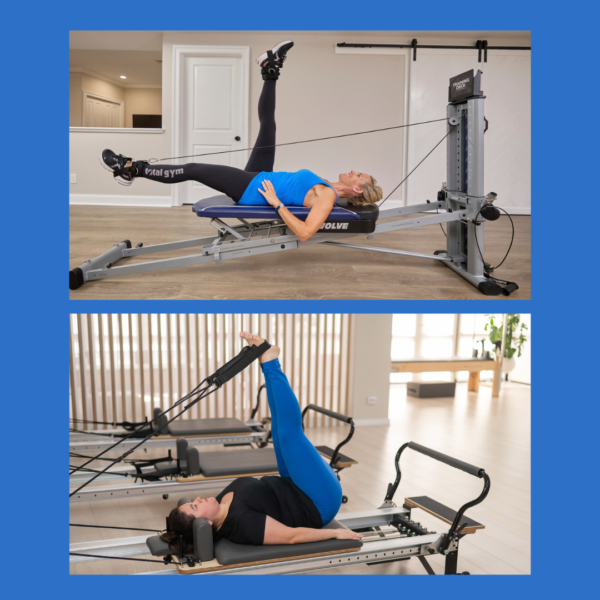
Why Pilates Lovers Are Falling in Love with the Total Gym

Why Pilates lovers use the Total Gym

What if your home workout could deliver the precision of a Pilates reformer and the versatility of a full studio in one compact, accessible system? That’s the power of the Total Gym.

As a Pilates instructor, I’ve always loved the precision and control a reformer offers. What I appreciate about the Total Gym is how nice it is to have something at home that recreates the same feeling on one integrated system.

From Reformer to Total Gym: The Perfect Transformation

What makes the Total Gym so unique for Pilates is how seamlessly it adapts to reformer-style movement without the need for springs. Using the adjustable incline, gravity, and your own bodyweight, it delivers customizable resistance that lets your body move freely through all ranges of motion.

Adjust the incline, add the proper attachments, and you’re all set to move with accuracy, control, and a level of challenge that meets every body where they are.

For those familiar with a reformer, here’s how the Total Gym translates:

  • The glideboard acts as your moving carriage.
  • The incline becomes your strength dial.
  • Your bodyweight, combined with the incline, provides the resistance instead of springs.

Together, these elements create a reformer-inspired experience that supports precision, spinal articulation, and the controlled flow Pilates is known for.

Pilates Accessories That Make the Total Gym Shine

The Pilates attachments are what truly set the Total Gym apart. These accessories are thoughtfully designed with the Pilates principles in mind to perform reformer-style movements.

Padded Squat Stand / Toe Bar

The Padded Squat Stand is one of the most versatile Pilates accessory on your Total Gym. It functions like a jumpboard on a reformer, providing a non-slip, cushioned surface that absorbs impact and protects your joints during dynamic movements.

It also easily converts into a Toe Bar, giving you the ability to perform classic Pilates exercises safely and effectively. You can use it for:

  • Footwork series
  • Bridge variations
  • Mermaid stretches
  • Upper and lower body work
  • Moves for mobility, flexibility, and restorative stretches

More advanced reformer-style exercises, such as Snake and Plank variations, are also possible by adjusting the incline and body positioning.

Leg Pulley System

The Leg Pulley System replicates the classic “legs in straps” experience of a reformer.  It provides precise control over each movement and allows you to strengthen and lengthen your legs through a variety of angles. This system makes reformer-style exercises accessible for every body, from beginners to advanced movers.

Exercises you can perform include:

  • Side-lying leg series
  • Adductor and abductor
  • Hip circles
  • Leg Circles and Sweeps
  • Single Leg Movements
  • Frog
  • Figure 4 Stretch

Adjustable Incline

The Adjustable Incline is the most pivotal feature on your Total Gym that adds versatility to your practice. By changing the incline, you can provide support for movements when you need it or increase resistance to challenge your strength and flexibility. This adaptability allows you to perform Pilates exercises safely at any level, while promoting gradual improvement.

As your strength and flexibility grow, the incline can be continually adjusted to maintain an appropriate challenge and keep progress moving forward. Key exercises include:

  • Roll Up
  • Teaser
  • Runners Lunge
  • Planks and Pike variations

The incline is what allows every Pilates exercise on the Total Gym to be progressive, safe, and effective, giving you a true reformer-inspired experience.

Cables

What makes Pilates on the Total Gym unique is how the Cables let you move with the same control and precision as a reformer. They create fluid resistance that responds to your body by engaging the core and muscle stabilizers. This connection between the glideboard, the cables, and the adjustable incline allows for seamless transitions through Pilates movements to build strength, control, and refine body awareness.

You can perform a wide range of Pilates-inspired movements, including:

  • Abdominal series and assisted Roll Ups
  • Pulling straps and Arm Circles
  • Teaser variations
  • Functional flows for upper and lower body

Why the Total Gym Feels So Good

By design, the Total Gym moves with you.  The glideboard travels with your spine, helping you articulate each segment. The cables allow dynamic mobility, flowing naturally through all planes of motion. The incline adjusts instantly, making every exercise accessible, functional, and responsive to your strength and flexibility. For Pilates lovers, it feels intuitive, fluid, and reformer-like, yet far more versatile.

Pilates Plus More

The Total Gym supports every classical and contemporary Pilates pattern you love. It also lets you seamlessly expand into strength training, cardio circuits, HIIT, flexibility sessions, physical therapy–style mobility work, and yoga fusion flows. This makes the Total Gym the most comprehensive home studio solution. And when your workout is done, it folds easily for convenient storage.

Total Gym Pilates Workouts

You’ll never run out of ways to train. The Total Gym TV app offers full Pilates workouts, and my blogs provide additional guidance. Here are a few to check out:

Consider the Total Gym for Pilates Training

Should you consider the Total Gym for Pilates?  Absolutely! And here’s why:

  • It feels like Pilates.
  • It functions like a reformer.
  • It transforms your home into your very own Pilates studio!

If you’re exploring home Pilates equipment or want a system that adapts to your strength, flexibility, and goals, the Total Gym deserves a top spot on your list.

Check out the Pilates Kit and the Pilates Kit for FIT.

Discover the Total Gym and start your Pilates practice today!

The post Why Pilates Lovers Are Falling in Love with the Total Gym appeared first on Total Gym Pulse.

Train Like an Olympian with Total Gym – Part 2

Train Like a Winter Olympian

Building the Complete Winter Athlete

Part 2: Mobility, Coordination, and Recovery Mid-Season Performance Maria Sollon, MS, CSCS, PES

Mid-season is where the body’s foundation is tested. What keeps athletes performing consistently is how well they are conditioned. This requires training smart to maintain movement, preserve joint health, and recover between sessions. This is the focus of Part 2: how to move and maintain through the season.

Train Like a Winter Olympian: Series Overview

This two-part series is designed to build the complete winter athlete.

Part 1 focused on strength, stability, joint control, and core integrity; the foundation for safe, powerful movement. If you missed it, it’s worth reviewing to understand the base we’re building from.

Part 2 focuses on mobility, coordination, and recovery. These are the tools that keep the body moving efficiently, protect the joints, and keep the nervous system sharp throughout the season.

The exercises in Part 2 include sport-specific movements that can be performed on your Total Gym, indoors with a band, or outdoors in winter conditions.  Some were filmed in the snow to show how athletes train for unstable surfaces and cold climates, but all can be adapted for indoor practice by mimicking the same movements on stable surfaces.

Even if you aren’t a winter athlete, these drills improve balance, control, and resilience.  It’s the same qualities Olympic athletes rely on.

Mobility, Coordination, and Recovery

Mobility is the ability to move a joint through its full, usable range of motion with control. It is not passive flexibility. It requires strength, stability, and neuromuscular awareness at end ranges. In-season mobility work preserves joint integrity, reduces unnecessary compensation, and allows force to transfer efficiently through the kinetic chain.

Coordination is the integration of multiple systems working together smoothly. It reflects how well the nervous system organizes timing, sequencing, and precision under load. As training volume accumulates, coordination ensures that movement patterns remain efficient rather than becoming rigid or reactive.

Recovery is the process that allows adaptation to occur. It includes restoring tissue quality, regulating nervous system output, and managing cumulative stress. In-season recovery is not downtime; it is structured input that keeps the body responsive and capable of repeated performance.

Together, these qualities sustain strength. They ensure that power remains controlled, joints remain resilient, and movement remains efficient throughout the demands of the season.

Mobility, Coordination, and Recovery Mid-Season Performance

The following exercises offer a variety of movements that all serve a common purpose: maintain movement quality, preserve joint integrity, and sustain performance throughout the season.

  • The Total Gym exercises emphasize active mobility, joint strength maintenance, core control, and recovery integration.
  • The Functional Movement bodyweight drills emphasize dynamic strength, flexibility, eccentric control, reactive balance, and full body coordination.
  • The functional strength drills are demonstrated in winter terrain to challenge balance, sequencing, and adaptability in real conditions.

Check out the video to see each movement demonstrated so you can implement these season-ready drills into your training.

Total Gym Exercises

Single Leg Deadlift

  • Focus: Develops single-leg stability and force control.

Step Up Crossover

  • Focus: Build strength, joint stability, and balance through varied angles of motion.

Reverse Lunge Touch Down

  • Focus: Builds strength, balance, and controlled deceleration as you tap the floor in multiple directions around the front leg.

(Connect Cables)

Chop Variations: bilateral, unilateral (modify: seated, adv: high kneeling)

  • Focus: Strengthens shoulder stability and rotational core control to improve force transfer between the upper and lower body.
    • Bilateral Chop (both arms): Focus on generating rotation from the core and hips. Both shoulders work together to strengthen rotational control.
    • Unilateral Chop (one arm): Rotate from the core. The working arm targets the rotator cuff, while the opposite arm engages chest and anterior deltoid.

Snow Angels

  • Focus: Develops posterior chain strength in upper and lower body while enhancing coordination through synchronized arm and leg movement.

Functional Movement Drills

These exercises challenge balance, joint stability, core control, and dynamic mobility. These exercises were filmed in snow for sport-specific context, but they can be adapted for indoors or on stable surfaces. The snowy environment adds challenge, but the intention behind each movement is what drives adaptation.

Even if you are not a winter athlete, you can still train like one!

Crossover Lateral Lunge

  • Focus: Develops core balance, dynamic weight transfer, and knee joint stability.
  • Do: Step out to the side into a lateral lunge, keeping the lunging leg aligned nose-to-knee-to-toe. Shift into a cross-over lunge with the same leg.

Standing Lift, Kneeling Lean

  • Focus: Opens hip flexors, stretches the torso, and challenges single-leg stability.
  • Do: Stand on one leg, lift the other into a split, then drop that leg into a kneeling lunge while reaching back toward the kneeling heel.

Matrix Taps

  • Focus: Builds dynamic core balance, coordination, and fluid weight transfer.
  • Do: Begin standing, shift weight forward to move into a kneeling position while tapping a hand toward the heel, then return to standing.

Snow Angel Rolls

  • Focus: Develops dynamic core power, spinal mobility, and full-body coordination.
  • Do: Start with a snow angel, then perform a hollow-body roll into a V-sit, alternating leg lifts or bending knees to chest.

Directional Lunge Stretches:

  • Focus: Enhances hip mobility, flexibility, and strengthens the joint through varied ranges of motion.
  • Do: From a kneeling runner’s lunge, move the front leg into different angles to deepen the hip stretch while maintaining control.

Perform. Recover. Repeat.

Winter sports demand power, control, endurance, and resilience. The athletes we watch on the Olympic stage sustain their performance because their training is structured, intentional, and built to last through an entire season.

This two-part series is designed to help you do the same in your own training: build strength, preserve mobility, prioritize recovery, and repeat consistently. Strength drives performance. Mobility and recovery allow you to sustain that performance.

When the season ends, post-season maintenance becomes the bridge to your next training phase. If you are interested in understanding how those phases connect, explore my blog on periodization and long-term athletic development:

https://blog.totalgymdirect.com/understanding-periodization

Move with purpose, recover with intention, and maintain your edge all season long.Maria

@groovysweat

The post Train Like an Olympian with Total Gym – Part 2 appeared first on Total Gym Pulse.

The Shamrock Shakedown Total Gym Core Challenge

The Shamrock Shakedown Total Gym Core Challenge

It’s time to shake up your workout with a lucky core challenge on your Total Gym! 🍀

Whether you’re 100% Irish or just claiming a little luck this March, the Shamrock Shakedown is your chance to fire up your core, test your endurance, and keep your energy rolling from start to finish.

Consider this your lucky core challenge for the month of March. Repeat it anytime to build core strength and stamina for the season ahead. The challenge consists of 4 lucky exercises, 17 reps per move, 7 rounds in circuit format, and a continual incline adjustment that keeps your muscles guessing. Simple to perform, smartly sequenced, and designed to leave your core strong and ready for spring.

Lucky Number Rules

  • 4 exercises (channeling a four-leaf clover)
  • 7 lucky rounds
  • 17 reps per exercise (lucky 17 for St. Patrick’s Day)

The Shake Down Twist

Begin at a high incline and lower it each round. Feel the burn shift, keep your core engaged, and power through. Every round is a lucky shake down!

Modification Option:

If a high incline isn’t accessible, use at least 3 adjustable levels, repeating 2–3 rounds at each level before lowering.

Lucky Challenge Tip:

Don’t rush the reps. Focus on precision, posture, and steady breathing. As the incline lowers, fatigue from previous rounds will keep the challenge alive.

Four-Leaf Core Circuit

  • Perform these 4 moves back-to-back each round for 7 total rounds, 17 reps per exercise.
  • Adjust the incline each round or repeat at a level that works for you.
  1. Plank Knee Tucks (advanced: hands on floor)
  2. Ab Crunch: Knee Tucks
  3. Plank Saw
  4. Ab Crunch: Oblique Swivels (modify: knees on glideboard)

Check out the video to see a demonstration of how these four lucky core exercises are performed on your Total Gym.

Ready for the Shakedown?

This challenge is quick, effective, and repeatable all month long. Add it to your routine a few times a week and watch your endurance and core strength improve.

Give the Shamrock Shakedown a try and share how it goes with the Total Gym community. How many rounds can you complete with perfect form?

Tag me so I can cheer you on! @groovysweat
By the end of the month, your core might feel stronger than a pot of gold. 🍀

Good Luck Always,

Maria

Let’s connect: @groovysweat

The post The Shamrock Shakedown Total Gym Core Challenge appeared first on Total Gym Pulse.

Improve Your Balance on Total Gym

Balance…If You Don’t Use It – You’ll Lose It! Improve Your Balance on Total Gym

Hey Total Gym team! It’s Master Trainer JayDee here with a quick quiz to kick off this informative blog:

  • Is losing your balance a natural part of aging?
  • Is becoming less physically stable as we age something we should just accept?
  • Isn’t there something we can do to thwart the loss of balance and even improve it?

If you answered:

  • A little… but mainly NO
  • Hell NO!
  • And an emphatic YES!

…to those three questions, you’re going to love this blog and vlog.

Here’s the deal, team:

As we age, there are a few balance-related factors that can degrade over time, such as vision and nerve reaction speed. But for the most part, the reason most people’s balance declines with age is simple—as people get older, they stop doing things that challenge their balance.

Does that make sense? Hence the adage in the title of this blog:
If you dont use it — youll lose it!”

Yep—if your primary activity is sitting around eating bonbons and binging Netflix all day, your balance is going to suffer. Your joints will stiffen. The muscles that support your skeleton will atrophy and weaken. And the parts of your brain needed for good balance will become duller.

But not my Total Gym peeps!

You’re keeping your muscles strong with consistent workouts. You’re keeping your tendons, joints, and ligaments lubricated. And if you add in exercises that challenge your balance—like the ones you’ll experience in this video—your body and brain will stay sharp. And yes, you can actually improve your balance.

Losing your balance as you get older can be a serious issue—sometimes even fatal. You’ve probably heard the story many times: an older adult falls, breaks a hip, ends up in the hospital, and never makes it home for various reasons. All because they stopped doing activities that maintained their balance.

On the other side of that bleak coin, I’ve seen adults in their 70s and 80s performing impressive balance poses in yoga classes I attend. My meditation mentor is now in her late 80s and loves doing headstands. No, she’s not a circus freak—she simply challenges her balance every day by staying active and practicing yoga. On a whim, she’ll just pop up into a headstand. It’s comical—and awesome.

Now it’s time to check out the video and learn three vital components to keeping your balance sharp:

1. Challenging Your Vestibular System

This is the part of your inner ear that helps you maintain balance, posture, and your sense of motion. It tells your brain where your head is and how it’s moving—even when your eyes are closed.

2. Adding Instability to Progress Your Balance

I show examples of how to gradually layer in instability to increase your balance challenge. Your body craves homeostasis and is always searching for stability. As soon as you “rock that stability boat,” your brain and body kick in to keep you from falling.
Bonus: Your core musculature fires automatically to help make this happen.

3. Using Unilateral Arm & Leg Movements

Once again, we create more instability to increase the balance challenge—keeping your body and brain balance-ready.

Bonus: This balance series also doubles as a great leg workout!

Thanks, TG Team! Keep the questions and comments coming. I love this stuff, and I’m here to help.

The post Improve Your Balance on Total Gym appeared first on Total Gym Pulse.

Train Like an Olympian With Total Gym

Train Like a Winter Olympian – Building the Complete Winter Athlete

Part 1: Strength, Stability, and Control

This year’s Winter Olympics did not disappoint. The performances delivered by each athlete are a reminder of the consistent, structured training required to execute movement with such precision under pressure.

When we watch the Winter Olympics, we see speed, power, precision, and fearlessness. What we do not see is the foundation that makes those performances possible.

Before Olympic athletes cut down the mountain or spin on the ice for gold, they spend years developing the foundational qualities that allow their body to handle force, control movement, and repeat high-effort actions safely.

This foundation allows their bodies and minds to perform efficiently under intense stress and pressure.

You don’t have to be an Olympic athlete to train with purpose and elevate your performance during the colder months. Whether you ski recreationally, compete in winter sports, or simply want to move better and feel stronger, let the Winter Games inspire you to take your training to the next level and go for gold in your own way.

Series Overview: Train Like a Winter Olympian

This two part blog series explores the physical qualities that support sustainable performance. Together, these articles address muscular strength, joint strength, stability, balance, coordination, core control, power absorption, and mental focus.

Each part builds on the other.

Part 1: Strength, Stability, and Control
Part 2: Mobility, Coordination, and Recovery

The exercises included can be performed on your Total Gym, in a traditional gym setting, or outdoors. Several movements were intentionally filmed in the snow to challenge stability and highlight sport-specific adaptations. Every exercise can also be replicated on stable ground or indoors, so you can train effectively in any environment.

Be sure to watch the accompanying video for full demonstrations of each movement.

The Foundation of the Complete Winter Athlete

Every high performing winter athlete relies on the same foundational attributes before explosive power and speed are layered on top. The theme of this phase of training is simple:  Controlled movement to maximize physical output (force).

The foundational qualities include:

  • Muscle strength
  • Joint strength and control
  • Tendon integrity
  • Stability
  • Balance
  • Coordination
  • Core power and control
  • Force absorption during landings and deceleration
  • Mental strength and focus

These qualities are essential. They create the foundation that allows power, speed, and agility to be delivered safely. This phase of training is not about intensity. It’s about developing the capacity to handle load, control movement, and repeat high-effort actions without breakdown.

Strength and Joint Strength

Strength is more than lifting weight. It’s the ability of your muscles to produce force while your joints remain supported and aligned.

Joint strength means the connective tissues surrounding the knees, hips, ankles, and shoulders are prepared to tolerate load. In winter sports especially, these joints must absorb impact, control deceleration, and stabilize the body on unpredictable surfaces.

Proper strength development reinforces tendon integrity and enhances force transfer across the joints. Intentional strength training makes the body more resilient and capable of repeated high-effort performance.

Stability

Stability is the ability to control your body’s position during movement.

In winter environments, surfaces shift, snow compresses, and ice is unstable. Stability training teaches the body to maintain alignment even when the ground beneath you changes. This quality protects joints, improves movement efficiency, and ensures that force is transferred safely through the kinetic chain.

Without stability, strength cannot be applied efficiently.

Balance

Balance is dynamic and reactive. It is the ability to maintain control while moving, turning, landing, or reacting to external forces.

Winter athletes rely on balance every second they perform. The ability to adjust quickly and remain centered reduces unnecessary strain and improves reaction time. Balance training enhances proprioception, and your body’s awareness of position in space, which is critical when conditions are unpredictable.

Coordination

Coordination reflects how efficiently your nervous system communicates with your muscles. It allows the upper and lower body to work together in a synchronized manner. When coordination is developed, movement becomes smoother, more precise, and more controlled.

At higher speeds, coordination determines whether force is expressed efficiently or wasted. It is strength guided by timing and sequencing.

Core Power and Control

The core connects the upper and lower body. It stabilizes the spine while allowing force to transfer efficiently.

Core power is the ability to generate force from the center of the body. Core control ensures that this force is directed safely and intentionally. Together, they support rotation, deceleration, and directional changes without excessive stress on the lower back or hips.

A strong core maintains structural integrity and enables efficient movement.

Mental Strength and Focus

Mental strength allows athletes to remain composed under pressure, maintain focus during fatigue, and execute movements with intention.

Training with focus during foundational work builds discipline. It reinforces movement quality and builds confidence. When the body is prepared and the mind is steady, performance becomes repeatable.

Capacity Over Intensity

Foundational training builds preparation. It develops the ability to handle load, control movement, absorb force, and repeat high-effort actions safely throughout the season. This is where the complete winter athlete begins.

Applying the Foundation: Strength and Control in Action

Now that we’ve covered the foundational qualities of a complete winter athlete, it’s time to put them into practice. These exercises target strength, stability, and control, and can be performed on your Total Gym, in a gym, or outdoors in real winter terrain. Some were filmed in the snow to show how athletes train on unpredictable surfaces and in cold climates, but all can be adapted for indoor or stable environments.

These movements can be used as a full workout or integrated into your regular training routine. Focus on smooth control, full range of motion, and mindful absorption of force with every repetition.

Be sure to watch the video for full exercise demonstrations. Whether you have a Total Gym, train indoors, or take your workout outside, every exercise can be adapted. You can train like a Winter Olympian anywhere.

Total Gym Focus

  • Develop joint strength and control
  • Strengthen core for efficient force transfer
  • Improve tendon integrity and muscular endurance
  • Build stability and controlled movement under load

(Squat Stand)

Side- Side Hop Overs (standing)

  • Focus: Develops lateral stability and reactive balance develops lateral stability and reactive balance

Single Leg Hops (standing or supine)

  • Focus: trains tendon resilience and landing mechanics

Mogul Hops (bilateral / unilateral / supine / V-sit)

  • Focus: reinforces ankle, knee, and hip stability

(Remove Squat Stand)

Lateral Lunge Touch Down

  • Focus: builds hip and ankle stability while reinforcing controlled movement

Roll Over Taps (Adv: roll up, kneel to floor)

  • Focus: improves core power and control, joint flexibility and reaction, coordination

Functional Drills

  • Enhance reactive balance and proprioception
  • Train landing stability and deceleration control
  • Adapt to variable terrain and environmental challenges

Lateral Leap Hold

Focus: Enhances lateral power, balance, core control, ankle stability, and joint strength

Do: Leap laterally from side to side and stabilize each landing with control before repeating.

Lunge Drop Pivots

Focus: Develops explosive power while improving deceleration control and hip and knee joint strength

Do: From a lunge stance, perform one explosive drop into the lunge and decelerate with control. Stay low and pivot to the opposite side to repeat. Advance by performing continuous 180 degree lunge drop hops without pivoting.

Kneel to Stand 180

Focus: Trains core power, dynamic stability, and rotational balance
Do: Start standing. Bend the knees to tap the floor, then return to standing without using the hands. Use core driven power to hop and rotate 180 degrees to repeat on the opposite side.

Frog Hop Lean Back

Focus: Develops dynamic core strength and spinal mobility
Do: Hop forward and backward using the hands and a deep knee bend. Lean back to challenge spinal mobility while maintaining core control.

How to Use These Movements:

Start with the Total Gym exercises to develop strength, control, and capacity in a stable environment. Once comfortable, challenge yourself with the functional or snow drills to apply those qualities under variable conditions. Both approaches complement each other and prepare your body for any winter sport or recreational activity.

In Part 2, we build on this base. The focus shifts to mobility, refined coordination, and recovery strategies that maintain movement quality and resilience so performance can be repeated week after week.

We are all gold in our own arena. Being built like a Winter Olympian is not about one moment… it’s about sustaining strength, control, and confidence over time.

Train with purpose.

Maria

@groovysweat

The post Train Like an Olympian With Total Gym appeared first on Total Gym Pulse.